Saturday, 22 February 2014

Hunting Knife

Every now and then a really beautiful knife comes my way and I love the opportunity to not only make it sharp but make it LOOK sharp as well.

I used about 10 different stones on this knife starting with an ATOMA 140 diamond plate (Not really a stone of course) and finishing with a Shapton Pro 15,000.

Cool eh.


Tuesday, 18 February 2014

More Japanese Knife stuff


If you are like me, anything Japanese is pretty cool. I've been to Japan and it truly is an amazing place  and if you are into knives and knife sharpening, it is a place you just don't want to leave.


The two knives pictured below are both from the Tojiro DP line and the newest one that I have for sale is the Nakiri, the beauty on the top. The Nakiri is designed for cutting vegetables although my wife uses it for everything, it's her favourite knife.


Tojiro DP Nakiri and Chefs Knife


Nice huh :)

Let me know if you are interested.

Ask me if these are sharp.

Tuesday, 11 February 2014

I want to buy a knife but I want to make a smart purchase.

Hello friends.
You have decided to purchase a knife for yourself or for a friend or family.  Good, I hope this blog entry helps steer you in the right direction and prevents you from making some of the mistakes I have in the past.

Let's just say you already have some knives, you just want to upgrade or add to your collection, or, you just to get that feeling back again, that special feeling that only a very sharp knife can deliver. Sadly, many folks only get to experience a sharp knife once, that is the day they buy the knife. After that, we all know what happens, the dulling process begins, that new car smell starts to disappear and the magic has vanished.

Here is a list of things I recommend you don't do:


  • Don't purchase a block of knives that are on sale for $75.99, even if they are Henckels. While it sounds like a good deal, the knives are low quality, they will not be that sharp when new and they will all get dull rapidly. Hey, I love Henckels knives, however there are about 11 different levels of Henckels. A block of knives soon leads to a block of dull knives and eventually a level of frustration that you don't need,  so stay away from them. I'm not saying a nice set of 3 good quality knives is bad, just those blocks of knives on sale that we have all seen and lure us in because we all love knives.
  • Don't purchase a knife because it looks good or because the beautiful girl behind the counter tells you it is an awesome knife. Do some research, go in with some knowledge about the hardness of the steel, don't let terms like Full Tang and Bolster impress you, they are just marketing terms. My favourite knives don't have bolsters as a matter of fact. I am not suggesting to avoid these things but if the salesperson is focusing on these items instead of asking "what you are going to be cutting?",  "would you like to hold it and see if it is the right fit for your hand?". Now there are some knife sellers out there who know their stuff, but with a little research you can go in there on equal footing perhaps. (Now if the girl is both knowledgeable and beautiful......buy the knife)
  • Don't get fooled into thinking a ceramic knife is going to be sharp for an eternity, they won't be, in fact I don't like them at all, ask me how hard they are to sharpen.
  • Don't think for a minute that there is knife out there that won't get dull. I had a 3,000 dollar knife in my hands that was useless, they get dull, you should in fact get used to the fact that you are going to make them dull. Heck, you should make it your goal, to make that knife dull because by doing so  you are using it for what it is made for.
Here is the most important tip I can offer.

HAVE A SHARPENING PLAN 

In other words, when you buy the knife you should be thinking "how am I going to keep this sharp".  So instead of blowing your budget on a  bunch of knives,  buy one really nice knife and one good Steel or Ceramic hone. This tool, when used often and properly will play a huge role in maintaining the edge. You need to know that this doesn't sharpen a knife, it keeps a sharp knife sharp. You can't let the knife get dull and then take out the Steel from it's hiding place in some secret cupboard and then brutalise the edge thinking it will be sharp again. Remember, the steel simply aligns the fatigued metal that has rolled over to the side, it pushes it back in place.  Eventually however, that metal needs to be removed by the process of sharpening, you hone a sharp knife, you sharpen a dull knife :)

Ceramic Hone 
Your plan can simply consist of investigating where you can take your knife to get professionally sharpened. You should do some research on that sharpener as well,  look for things like traditional,  or hand sharpening. Sharpening devices that are plugged in should trigger some alarms unless it is a good quality belt sander with sharpening belts. In the right hands they can go great work. 
It is just a matter of spending 10 minutes, call the person and you'll either have a good feeling or you will be looking elsewhere. 

I feel bad for people who buy their $500.00 dream knife and it becomes a source of frustration in a month because that knife is now dull, no better than the 30 dollar knife that your wife said was just as good when you went knife shopping. 

If you are food enthusiast, and love all things related to food then you can appreciate what a sharp knife means to the flavour of food. You know that a dull knife can seriously impact the flavour and even the look of some foods. Cut an apple with a dull knife and watch how fast it gets brown. 

Buy one good knife whether it is a Henckels, Wusthof, Miyabi or MAC,  or Japanese hand make carbon knife, have a plan to keep it sharp in week # 3 and beyond, keep that magic flowing. It's easy, I love nothing better than to take a dull knife and give life back to it.

Of course the best way to do it, and this is not always possible is to learn how to sharpen your own knives, then you will experience true joy. As long as you have a plan to keep it sharp though you will be fine.

Thank you so much for reading this.


Saturday, 1 February 2014

Japanese Kitchen Knives.......yes I have them.

This is why I bought mine, check out the nifty box :)

I am really excited to be able to sell to some individuals these Tojiro 8 inch knives. These are made of VG10 steel, they have a stainless cladding for easy care and I can tell you one thing, they are screaming sharp, they are relatively hard, 58-60 so they will maintain an edge for awhile, not an eternity of course but in a professional setting for a month or a little more.  (If anyone thinks a knife, regardless of the price will hold it's razor edge in a professional kitchen for longer, they are not being realistic.)

Now of course you can find a better quality knife at Paderno for example, heck yeah, their Bob Kramer knives are exceptional as are their high end Henckels and MAC's. The beauty of this knife is that it cuts like nothing I have experienced, and it is very easy to maintain including re-sharpening.  It's just a little different than the knives we can buy here that's all and they are priced very nicely too.

In fact, I think what really made this knife so popular among chefs is not just the performance  but the price. These knives will go for $120-$140.00 and there is no tax.  

So if you want to dive into a Japanese kitchen knife, and not a Shun or Global, give it a shot. (Not that there is anything wrong with a Shun or Global of course, those are cool too, I am often drooling over the ones Cucina Moderna sells)

These will be ordered as requested,  I am steering these towards professional chefs,  if you want one too it will take about 2 weeks to get it, the first ones were sold before they were even ordered.


To be honest, I'm not really concerned about selling them, I'm keeping one for myself and they will make fantastic gifts.  I am not criticising any other knife brands either, I will never do that, I'm just offering something different that's all, something cool and something very sharp.

Did I mention the box they come in?

Monday, 6 January 2014

The Edge Pro Professional

The EP Pro is a precision guided system that uses specially cut water stones that fit into a "stone arm" as seen above.


There is a pivot arm that is adjustable and allows me to select and lock in a precise angle and the system then forces me to maintain that precise angle while sharpening your knife.


Here is Grohmann knife on the Edge Pro bench, it is resting spot for the knife, the arm holding the stone is then moved back and forth over the edge of the knife and a precise angle.  It's pretty freakin cool actually. It is especially handy for short knives and knives with a odd shape. 

Also, there is a huge variety of extremely high quality Japanese Water Stones available, and even strops and diamond plates that have been all designed for the EP. 

This is a selection of some of stones I have for the system, all well used and there are even some specially sized stones for curved blades as seen on the bottom right column.

A brilliant sharpener by the name of Ben Dale invented the system, it is a proven device that after at least 2,000 knives has never let me down. I don't use it as much as I did before, I prefer to free hand but I depend on it every few days. 

There is also a very nifty scissor attachment to it that does an amazing job on scissors.


Exotic knife, handled beautifully by the Edge Pro.

Mirror Edges are attainable with this system.

I can't say enough about it, I'll never regret purchasing it from Ben years ago


Ulu, would have been tough by hand.


Sunday, 5 January 2014

Repair work - my favourite

I got some nice Shun's to repair recently, the chef knife had major tip damage as seen above and the edges of both knives required work.


Tip repair like this is achieved by working on the spine, not the edge. This way the length of the knife remains the same...........theoretically :)


Here are some after shots.


Pretty much anything can be fixed, you just need some patience and courage.

Sunday, 29 December 2013

Honing and Sharpening - The Difference

Hi, I used to wonder what the difference between honing a knife and sharpening a knife was.  I have a good idea now so I will pass it along.
This is important because a lot of folks tell me that "their husbands sharpen the knives at home" so out of curiosity I always ask how he does it. Most of the time the response is "with one of those sharpening rods"

So to get things straight right off the bat,  a "Steel" does not sharpen a knife, regardless of the fact that it may be advertised as a knife sharpener. A Steel, whether it is made of steel, or ceramic is designed to hone a knife and is for edge maintenance.

Honing
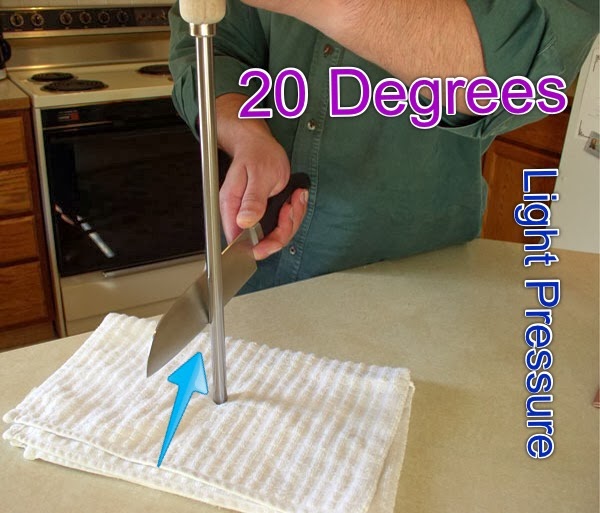
Honing or steeling will keep a sharp knife sharp for a period of time, one cannot say how long but I can say that the knife will stay sharper if it is steeled. A new or freshly sharpened knife has a series of micro serrations along the edge. Invisible but they are there and they bite into whatever it is your cutting. Over time, these tiny teeth are pushed over to the side, the edge of the metal is fragile and the metal along this point (the edge of the edge) gets fatigued and just folds over. A hone or steel when used properly as in the picture here will push that fatigued metal back into place.

There are some key points to this though. 
1. You need to begin the process with a sharp knife, you CANNOT pull a dull knife out of the drawer and hone it sharp, even if you have the best steel or ceramic in the world. 
2 You need to do this often, build it into your cooking regime, do it every day before you cut your food. So keep the steel handy, not somewhere you need to root around for it.
3. The steel that comes with a block of knives is usually very cheap, not worth the effort, get a new one.
4. Honing or Steeling only works for a while, once the knife remains dull after you steel it, i.e. if it doesn't feel any different, put the steel away, it is time for it to be Sharpened. 
5. Do not abuse the edge with over steeling, it doesn't do anything but make it more difficult to sharpen.
6. This is an important step in knife maintenance but it is not done by a lot of people. It is easy to do  and only takes 2 minutes. You only need to run the knife down the steel from heel to tip 5-8 times with a little pressure, ease off on the pressure the last couple of times.


So what is sharpening?:


Sharpening on a whetstone


To sharpen a knife, you need to remove that fatigued metal completely and expose the fresh steel underneath. A whetstone is the best way to do this, it doesn't take off much metal and can restore the edge to the factory level easily and with a little more effort you can make it sharper than that.

So Honing is knife maintenance, keeping a sharp knife sharp, sharpening is the removal of metal from both sides of the blade at the edge of the edge. 

Once is it is sharp it can be honed again until the cycle needs to be repeated.


Now there are diamond steels that claim to sharpen a knife by removing metal but again, that will only remove metal at the primary edge, what about the secondary bevel?  You can purchase a whetstone for 30 dollars and keep your knife sharp for a life time.

Now....it is possible to use a high grit stone to hone your knife by using a trailing motion like the picture above but the best setup is a good steel or even better a Ceramic rod and a whetstone or two.