I just cut and paste the info below from wikipedia to get things started
A serrated blade has a cutting edge that has many small points of contact with the material being cut. By having less contact area than a smooth blade, the applied pressure at each point of contact is relatively greater and the points of contact are at a sharper angle to the material being cut. This causes a cutting action that involves many small splits in the surface of the material being cut, which cumulatively serve to cut the material along the line of the blade.
So, what about serrated knives:
There is no doubt that they excel (when sharp) at cutting bread, especially crusty breads. This is because of the multiple points of contact and those multiple pressure points, which are sharp doing their job. However, when they get dull, it can be a challenge to sharpen them but not as difficult as you may think.
However, if you don't have someone to sharpen them for you and you don't want to sharpen them yourself you are stuck with a dull knife right? (no different than all the other dull knives that many folks use)
I recommend that if you like the serrated knives, then don't purchase expensive ones. Get a cheap one for $20.00 and just replace it when it is dull. These knives stay sharper for a longer period than regular knives, so you can a year out of one, just throw it away and get a new one.
Now.....let's say you have gone out and purchased a beautiful MAC serrated knife for 200 dollars and it's getting dull, or a Shun, they are quite beautiful knives and obviously you are not going to throw those away.
How do you sharpen them (besides letting me do it of course)?
Here is the quick and dirty of one way to do it but if you don't have the tools, well, you're going to have to send it to me or someone else.
Here is a simple and cheap way. Get yourself a wooden dowel the same size as the serrations, i.e the diameter of the dowel is such that it will fit nicely inside a serration on your knife. NOW get some wet/dry sandpaper in various grits, 320, 600 and 1000 grit. Not expensive at all.
Now hold the blade on the edge of a table or counter top in such a fashion that the edge is hanging over the side but you can grab the handle so it would be on a corner for example.
I will get some pictures posted soon.
Now you just run that dowel with the sandpaper (320 first) wrapped around it and you hold it at an angle that matches the serrations and run the dowel down the serrated side. Basically, you are sanding off the dull parts of the serrations and you do this on every single serration with the different grits. Do the whole blade with the 320 grit then repeat with the other grits.
Now, the goal is to for a burr on the back (flat) side of the knife, if you have done that, you are going to have a sharp knife assuming you remove burr and that is the tricky part if you don't have water stone. If you did have a water stone you could flip the knife over and just carefully run the stone over the back of the knife at a very low angle to remove the burr.
If you had a ceramic rod you could do the same but you need to remove that burr.
I will publish some pictures that illustrates what I am talking about.
(Now you know why I say to buy an inexpensive serrated knife)
Saturday, 5 October 2013

What about ceramic knives
I think at some point most of us are lured into the idea of using a ceramic blade. I know I was and I picked one up ages ago. I believe that the best ceramic knives are made by a company called Kyocera but you can also get them at Paderno in Bayer's Lake and many other spots.
They are not expensive and some may like the very light feel to them.
I HATE them, Im just putting it out there right now, I would never own another one. I didn't find it particularly sharp when new and they are brutal to sharpen. Now I think Kyocera offers free sharpening if you want to ship the knife there. I just don't know why anyone would want one with all the beautiful steel knives out there that are easy to sharpen and are much much sharper.
Now if you have ceramic knives and you love them, as I suspect you do, I can sharpen them. I had to purchase some special diamond plates for my Edge Pro but it isn't something I enjoy doing.
Now having said that, I do believe a new ceramic knife will do a very nice job in the kitchen on both veggies and proteins, they are easy to keep clean and will likely hold their edge for a long time. I think that would be the one advantage that I can think of, a sharp ceramic knife will stay sharp longer than a sharp steel knife.
However, once they are dull, they will stay dull for a long long time.
 This is a ceramic knife that I repaired and sharpened, it took me forever to repair the edge and then even longer to sharpen, I mean longer than forever.
The funny thing about sharpening a ceramic is that there is no burr formation, you will NOT get a burr.
(I have never seen a serrated ceramic knife.....I wonder if there are any)
Did I tell you I don't like serrated knives either, I should talk about that.
I appreciate you visiting my blog.
They are not expensive and some may like the very light feel to them.
I HATE them, Im just putting it out there right now, I would never own another one. I didn't find it particularly sharp when new and they are brutal to sharpen. Now I think Kyocera offers free sharpening if you want to ship the knife there. I just don't know why anyone would want one with all the beautiful steel knives out there that are easy to sharpen and are much much sharper.
Now if you have ceramic knives and you love them, as I suspect you do, I can sharpen them. I had to purchase some special diamond plates for my Edge Pro but it isn't something I enjoy doing.
Now having said that, I do believe a new ceramic knife will do a very nice job in the kitchen on both veggies and proteins, they are easy to keep clean and will likely hold their edge for a long time. I think that would be the one advantage that I can think of, a sharp ceramic knife will stay sharp longer than a sharp steel knife.
However, once they are dull, they will stay dull for a long long time.

The funny thing about sharpening a ceramic is that there is no burr formation, you will NOT get a burr.
(I have never seen a serrated ceramic knife.....I wonder if there are any)
Did I tell you I don't like serrated knives either, I should talk about that.
I appreciate you visiting my blog.
Saturday, 21 September 2013
Why we need to thin
Folks,
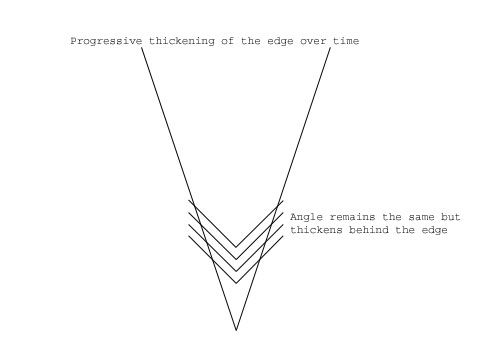
I found a couple of good diagrams that will help illustrate what happens when we don't thin a knife, i.e. this first picture is where the vast majority of knives are at now.
 So in the picture above, you can see how repeated sharpening to the primary bevel only (cutting edge) will gradually move that edge up into the belly of knife. Metal is removed when sharpening, it has to be otherwise it is not sharpening. Imagine a 10 or 20 year old knife that has been sharpened a few times or more, the original geometry of the knife is altered and the knife is not performing the way it should or could.
So I thin the knife by removing the metal as depicted in red in the diagram below:

It's a process that just knocks some of shoulder of the bevel off as seen in the bottom of this picture, and then to maintain the factory geometry or just create a better cutting knife, I keep the knife thin over time as I work on the primary bevel.
Machines don't do this.
I found a couple of good diagrams that will help illustrate what happens when we don't thin a knife, i.e. this first picture is where the vast majority of knives are at now.
So I thin the knife by removing the metal as depicted in red in the diagram below:
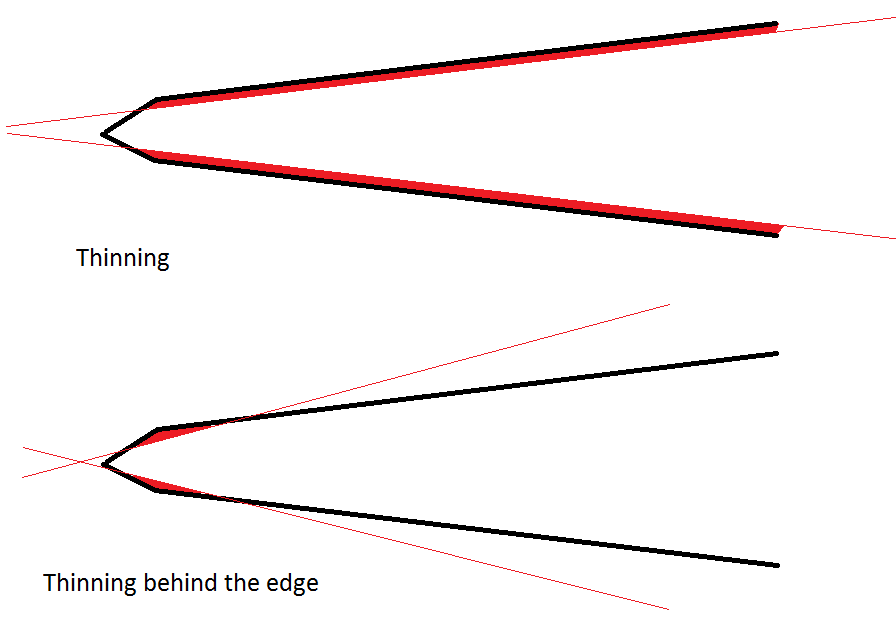
It's a process that just knocks some of shoulder of the bevel off as seen in the bottom of this picture, and then to maintain the factory geometry or just create a better cutting knife, I keep the knife thin over time as I work on the primary bevel.
Machines don't do this.
Sunday, 15 September 2013
Naturally Sharp
Hi,
I suppose you all know that there are different whet stones:
Oil Stones,
Synthetic Water Stones
Natural Water Stones
My favourite are Synthetic Japanese Water Stones and some of the best in the world are Shapton, Chosera and Arashiyama. There are many others too, Nubatama Bamboo, Imanishi for example
But what would happen if we took a beautiful stone like the Arashiyma 6,000 and created a slurry with a natural water stone, something in the 10, 000 grit range?
Well, I will tell you, it creates a beautifully polished edge that is both quite sharp and very functional in any kitchen. My friend Ken Schwartz, a gifted sharpener gave me a piece of a natural water stone that comes from caves in Kyoto Japan and with that piece I created a slurry, or muddy paste that can enhance the sharpening effect.
I was very pleased with the results.
The picture below is the amazing Arashiyama 6,000 grit Japanese Water Stone, man made with the natural water stone that I used as a Nagura stone to create the magical paste on top, the slurry.

I suppose you all know that there are different whet stones:
Oil Stones,
Synthetic Water Stones
Natural Water Stones
My favourite are Synthetic Japanese Water Stones and some of the best in the world are Shapton, Chosera and Arashiyama. There are many others too, Nubatama Bamboo, Imanishi for example
But what would happen if we took a beautiful stone like the Arashiyma 6,000 and created a slurry with a natural water stone, something in the 10, 000 grit range?
Well, I will tell you, it creates a beautifully polished edge that is both quite sharp and very functional in any kitchen. My friend Ken Schwartz, a gifted sharpener gave me a piece of a natural water stone that comes from caves in Kyoto Japan and with that piece I created a slurry, or muddy paste that can enhance the sharpening effect.
I was very pleased with the results.
The picture below is the amazing Arashiyama 6,000 grit Japanese Water Stone, man made with the natural water stone that I used as a Nagura stone to create the magical paste on top, the slurry.
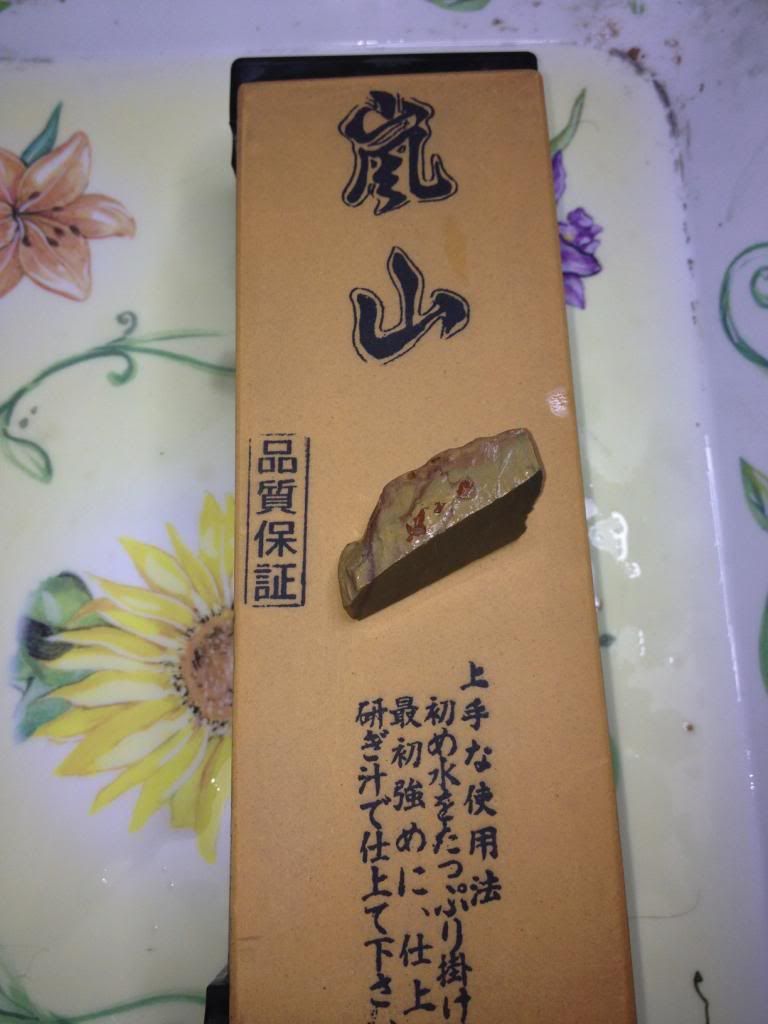
Sharpening knives is pretty freaking cool, this is just something that is fun to do, the results will vary with the knives/steel of course. At some point in time I will own some full size Natural Stones but that isn't something on my radar yet. I am not even saying that they are better for sharpening knives, however on traditional Japanese knives, you can create some beautiful finishes on them bevels with them.
Sunday, 8 September 2013
Some more before and after stuff.
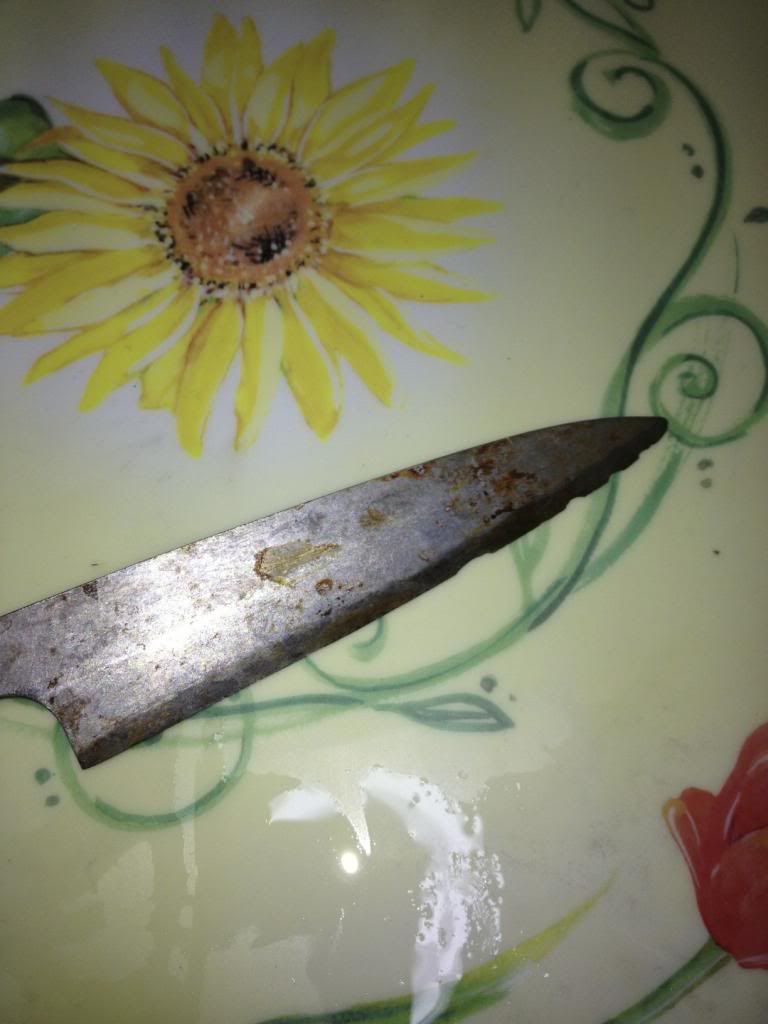
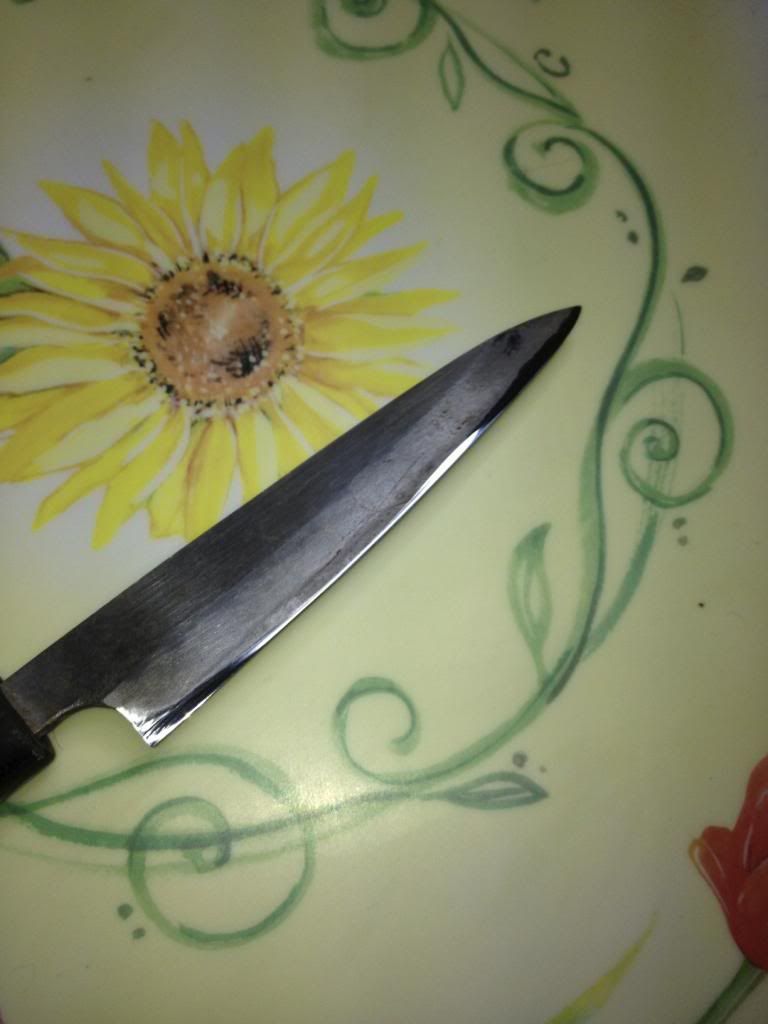
So this is a nice little Japanese hand made knife that has seen better days. These carbon knives can rust and chip easily if not taken care of properly but I promise you, they will perform better than your average European knife. (well not this one)
So the first step is to remove the rust and I use Bar Keepers Friend for that, I pick that up at Cucina Moderna. It's great for removing rust without scratching, I use a cork and make a little paste with the product. It is like Comet or Ajax but better for this particular purpose.
I then repaired the edge with a Belt Sander and some special Trizact belts, it's just a matter of being very cautious, using good lighting and taking your time.
After that I sharpened it up to 10,000 grit.
This is about an hours work in total, I hope the owner will be pleased:
Scissors
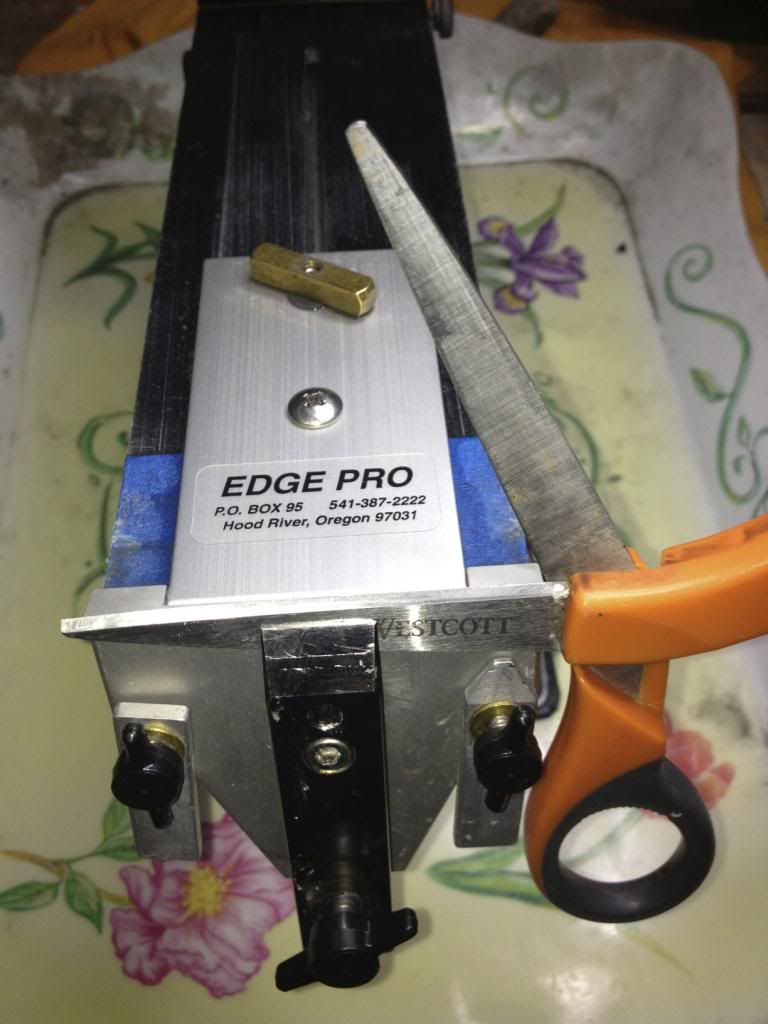
So I finally jumped off the fence and purchased the Scissors Attachment for my Edge Pro Professional.
I have not seen many reviews but I fully trust the designer. I was confident it would do a nice job on the everyday scissors. I am still waiting to find out how the salon shears are doing that I did.
 The system is quite amazing actually, I took this dull scissors back up to factory level sharp in 10 minutes using the same Japanese Water Stones that I do knives with.
I also did some grass shears with them, not the big shears, these are the smaller, scissor like Fiskar clippers that I use and they turned out great.
So give me your scissors, for $8.00 they will be sharp again, that's for the average size, smaller ones would be less.
I have not seen many reviews but I fully trust the designer. I was confident it would do a nice job on the everyday scissors. I am still waiting to find out how the salon shears are doing that I did.
I also did some grass shears with them, not the big shears, these are the smaller, scissor like Fiskar clippers that I use and they turned out great.
So give me your scissors, for $8.00 they will be sharp again, that's for the average size, smaller ones would be less.
Friday, 6 September 2013
Can I sharpen my own knives - I don't have any training?
Ok, you are wondering if you can actually get a knife sharp, you've never had a lesson.
I would say YES definitely, the fact that you are reading this means that you have an interest, that is a fantastic starting point. The process of getting a knife sharp is not difficult, you need to realize that there are many different levels of sharpness. All you need to do is make your knife sharp enough to work in the kitchen. It probably is dull now so if you measure a knife edge on a scale form 1 to 10, with 1 being dull, all you need is to take it up one notch.
It is only people like me who are not satisfied until we reach level 12, seriously, you have the ability to sharpen your knives.
I am amazed by people who would spend $200.00 on a Chef's Choice, which is likely the best of the electric sharpeners. Now for $200.00 I could buy some incredible Japanese Water Stones and get knives sharper than 95% of the people on earth have ever seen.
For $30.00 you could buy one water stone and get a knife far sharper than any machine. Now if you don't have any interest in sharpening knives by hand than yeah, go get that machine or just go buy new knives every 6 months or something but because you are reading this, I am guessing you have the urge to learn....good for you.

The knife pictured here cost $3,500 US. So imagine if someone gave that too you as a gift, or you won it or something. Knives like this, believe it or not, are no sharpened, the owner is expected to sharpen it. (This is a whole new topic). Now the knife is sharp, it will blow any new Henckels away.
Anyway, what do you do, imagine running a knife like this through the knife slayer, the Chef's Choice, gees, it was even hard typing that.
Don't hesitate to learn to sharpen a knife on your own, all you need is one stone to get started. All you need is to get to level 1, I could teach you that or just watch some videos.
You just need to understand what it is you are doing, what makes a dull knife sharp.
You are removing the fatigued metal by abrading it away with the water stone, you are exposing the fresh new metal underneath.You are getting side A and side B to meet. Pretty easy isn't it.
Get off the fence, and don't worry about ruining your knife, gees it isn't jewelllery, it's just a knife, you are not going to break it.
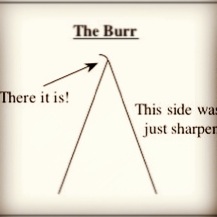
Here is the key, the Burr.
 Now get to it friends.
I would say YES definitely, the fact that you are reading this means that you have an interest, that is a fantastic starting point. The process of getting a knife sharp is not difficult, you need to realize that there are many different levels of sharpness. All you need to do is make your knife sharp enough to work in the kitchen. It probably is dull now so if you measure a knife edge on a scale form 1 to 10, with 1 being dull, all you need is to take it up one notch.
It is only people like me who are not satisfied until we reach level 12, seriously, you have the ability to sharpen your knives.
I am amazed by people who would spend $200.00 on a Chef's Choice, which is likely the best of the electric sharpeners. Now for $200.00 I could buy some incredible Japanese Water Stones and get knives sharper than 95% of the people on earth have ever seen.
For $30.00 you could buy one water stone and get a knife far sharper than any machine. Now if you don't have any interest in sharpening knives by hand than yeah, go get that machine or just go buy new knives every 6 months or something but because you are reading this, I am guessing you have the urge to learn....good for you.

The knife pictured here cost $3,500 US. So imagine if someone gave that too you as a gift, or you won it or something. Knives like this, believe it or not, are no sharpened, the owner is expected to sharpen it. (This is a whole new topic). Now the knife is sharp, it will blow any new Henckels away.
Anyway, what do you do, imagine running a knife like this through the knife slayer, the Chef's Choice, gees, it was even hard typing that.
Don't hesitate to learn to sharpen a knife on your own, all you need is one stone to get started. All you need is to get to level 1, I could teach you that or just watch some videos.
You just need to understand what it is you are doing, what makes a dull knife sharp.
You are removing the fatigued metal by abrading it away with the water stone, you are exposing the fresh new metal underneath.You are getting side A and side B to meet. Pretty easy isn't it.
Get off the fence, and don't worry about ruining your knife, gees it isn't jewelllery, it's just a knife, you are not going to break it.
Here is the key, the Burr.
Subscribe to:
Posts (Atom)