Tuesday, 22 January 2013

What I use to sharpen your knives

I thought I would share a few pictures of the items I use to sharpen knives.

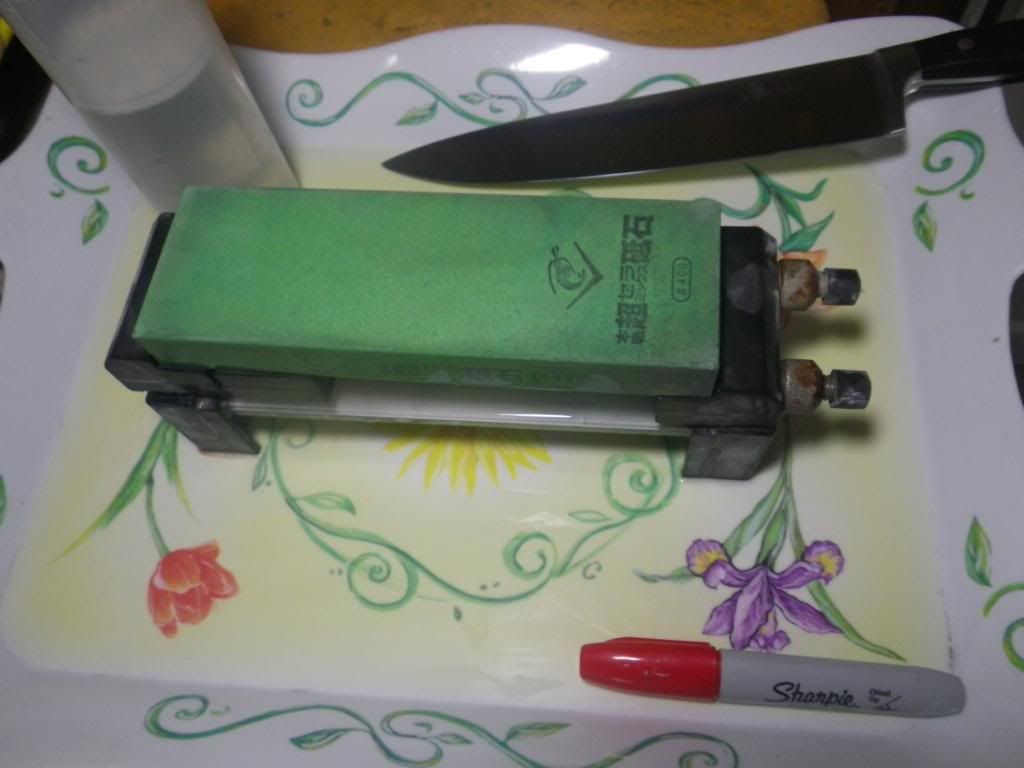
Coarse Stone
When I get a knife, any knife to sharpen, I start with a coarse stone, this could be a new knife. I set the bevels with the coarse stone. This one is a Naniwa Chosera 400 grit stone, absolutely amazing product.   The coarse stone is the most important stone in my opinion. This is the stone that will set you up for a successful sharpening. I raise a Burr with this stone on both sides of the knife, and then I remove it.  Now if the knife is relatively new or it hasn't been sharpened before the burr will come quickly with a stone like this. If the knife was unfortunate enough to go through a grinder of some type, it will take longer. I use a 400 or 500 stone, you can use an 800 or even 1,000 grit stone, it will just take a little longer to raise the burr. (you know by now that raising the burr and then removing it is essential, it is the key to knife sharpening)
Your goal here is to remove fatigued metal from the knife, the parts that have rolled over, this is why the knife is dull, you are going to a fresh new edge with the first stone.  When done properly, your knife is sharp, the dull parts are now gone, Swarf on the stone or in the water is all that remains.

From the coarse stone, I go to a medium grit stone, 1,000 or 2,000. I DO NOT move to this stone until I have raised the burr with the coarse stone. Time spent on this coarse stone is anywhere from 10 minutes to 45 minutes, it just depends on how dull the knife is. You can go lower than this, you can get a Nubatama 60 grit or Sigma 240 grit to start with.
Medium Stone
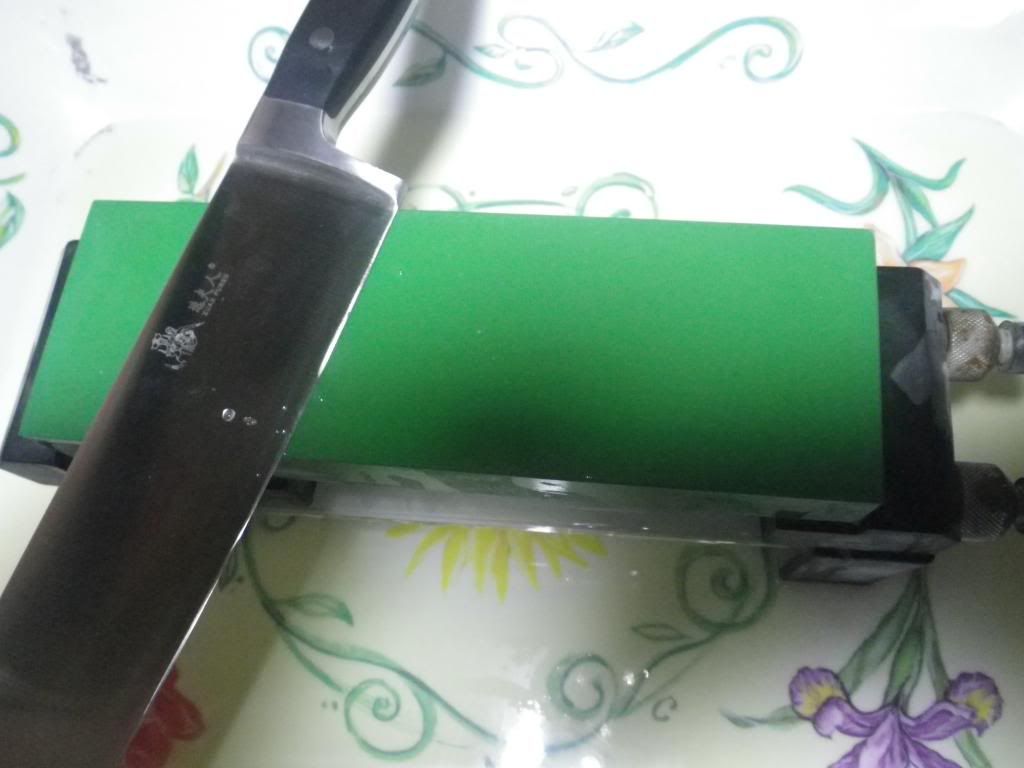
This is a Naniwa Chosera 1,000 grit stone, many consider this to be one of the best 1K stones in the world, i.e. synthetic stones. I absolutely love this one but any 1k or 2k stone will do the job.
NOW I am refining the EDGE, it is already sharp from the first stone. I have removed the fatigued metal and now I am going to progress in stones and remove any scratches left by the coarser stone.
It will get sharper and sharper but I am not trying to raise a burr now, one will likely form but now my goal is to refine the edge and to REMOVE any burr that forms. (Remember the formation of a new burr means you have removed metal from the edge, you don't need to do this again but doing so is no problem, it means you are hitting the edge correctly so just make sure it is removed)

Now some sharpeners will stop at this stone, in fact, many believe there is no need to go beyond 1,000 grit with European knives, even Shun knives are sharpened to 1,000 grit at the factory. Your knife will be perfect now for normal kitchen use, if you have used the right technique, the knife is likely sharper than when new. The time spent on the medium stone is not as long as the Coarse Stone. It could be five minutes.

Take the time to inspect the edge as you sharpen, a Loupe is great for this. Don't just blindly grind away and remove metal needlessly. If you are taking the time to read this and if you have gone out and got yourself some nice water stones than take the time to do it properly.

Impatience will be rewarded with poor results. Remember, don't go to the Medium Stone until your work is done on the Coarse Stone. Patience grasshopper.

Now lets go on some more, heck yeah, we don't to stop here. Lets use at least one for stone, a Fine Stone.
This is a finishing stone, your hard work was done with that all important Coarse Stone, then you removed the scratches and refined the edges with the Medium Stone. Now you are going to do some more refinement, make that edge looked polished and beautiful. You're about to cross the line here between a toothy edge and a more polished, smooth edge.

COOL eh.

Now here is a fine stone, and it is one of my favourites.
Fine Stone
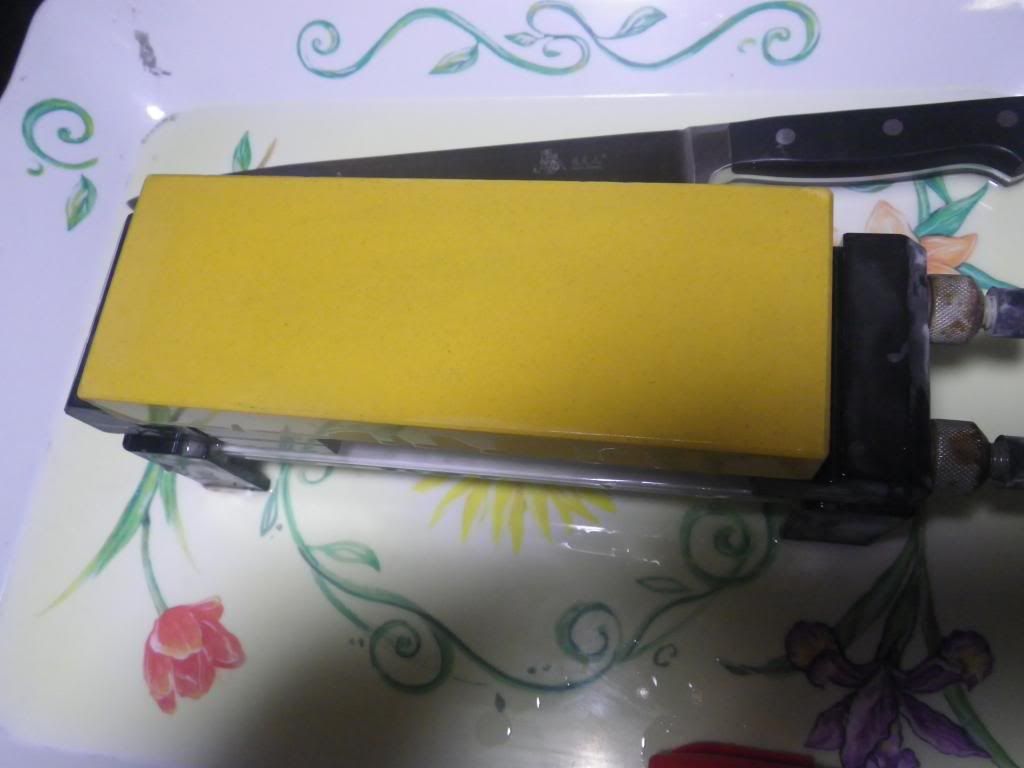
This is a beautiful 4,000 grit Imanishi that I got from Lee Valley. It is fantastic and the feel of this particular stone is like velvet.....oh yeah, now we're talking.

You will see that the stones are wet, always keep them wet with WATER (NEVER OIL), don't feel the need to was away slurry and swarf that forms on the stone, just keep it lubricated.

At this stage you are really just polishing the edge, removing scratches left by previous stones. You don't need any pressure here, be gentle and patient. FOCUS here, the edge will be quite polished after this stone, you will be startled perhaps by the way it looks and feels now.

For most knives, you really don't to go any further, you can of course but remember that if you polish the edge too much you are taking away any micro serrations, the tiny, invisible teeth in the edge that help it bite into something like a tomato.

Now I usually just polish my edges up to 4, 000 or 5, 000 grit. If I am doing a Japanese knife, I mean hand made Japanese knives (not Shun or Global or MAC), I will take it up to 8,000 grit.


Now if  you applying compound bevels, creating a Relief Face, you can polish that right up to your highest grit, I sure do.  Here is a very fine Japanese Water Stone. Overkill for sure folks.
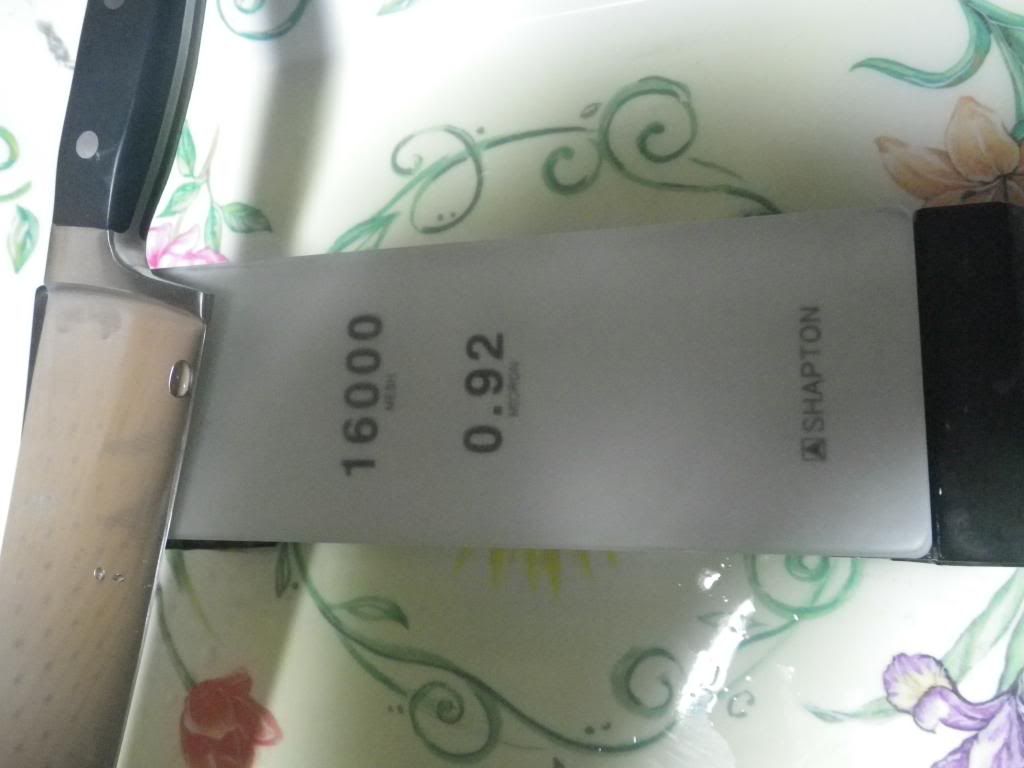
Shapton Glass 16,000
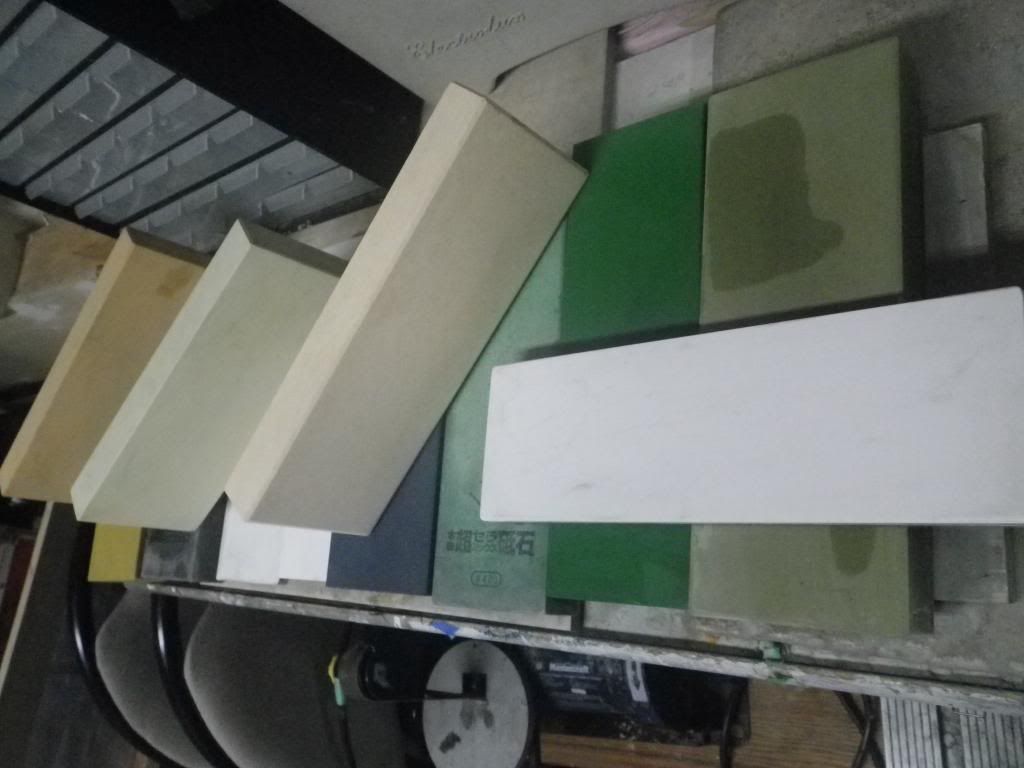
This is my current collection  but remember, this is a culmination of years of saving and and collecting. I sharpen professionally, you don't need these. In fact, you could get by with a single stone, a King 1,200 from Lee Valley for example.


For regular sharpening however, i.e. to take a knife that is very dull to extremely sharp I use 3 to 5 stones. If there is damage to the edge I need to fix that first of course. It happens a lot and greatly increases the time required to sharpen it.

Never hesitate to ask me to help you with sharpening, whether it is stone selection or just how to sharpen knives.

REMEMBER- Raise a burr on both sides of the knife and then remove it. This is what you need to do to kick start your knife sharpening session. Every single time with every knife, no exceptions. (Except Ceramic knives, they don't raise burrs)

Thanks for being here.


Friday, 18 January 2013

MY KNIFE IS SHARP ENOUGH

Friends,
I will admit that my standard for sharpness exceeds the majority of people out there and that I also have the luxury of being able to sharpen my own knives daily if necessary.
However, what I have noticed over the last couple of years is a common misconception that people have in thinking that their own knives are already sharp because they are new. Also....they are considered new by many if they were purchased within the last couple of years.

We all know how good it feels to use a brand new knife, it is really nice and sharp and it just enhances everything you do in the kitchen...................HOLD ON THERE:

That new knife in the vast majority of cases is not truly sharp,  nobody like me has sat down, hunched over an array of exquisite Japanese Water Stones and fretted about that knife, nobody looked at the edge under a loupe and made sure it was absolutely perfect and ready to go. No..in fact, it is likely that no human touched the blade. This is not to say that the knife isn't good or sharp, obviously it will be sharp enough to cut but it is just the starting point.  That new knife will not hold it's edge long, yet it will continue to be used, in many cases for years and years. Every now and then, the owner will take out a Steel and try to sharpen it and then think, ok it is good for another year. (Sorry it doesn't work that way)

The edge of the knife, the cutting edge is actually quite fragile, different steels will cause different results in edge retention but that edge will very soon start to roll over in places, that is what makes it dull. Hold the knife edge under a bright light, if you see the light reflecting back in spots along the edge, that is pieces of metal that has folded over. It happens with every metal knife and again, it happens very quickly, i.e. within a month of purchase.

This dull knife or knives will do nothing but cause frustration, all the things you love about cooking will start to fall off, you're going to hate those knives after a while. Did you know that cutting food with a dull knife is not only dangerous and frustrating.........you are changing the the way the food should taste.

The awesome part of all of this is that this can be all turned around. I can change that and make that knife sharper than it was when you purchased it. I will remove that fatigued metal, create a new edge and refine it, make it a joy to use, a knife that you will be looking for all the time and telling your friends about.

(I can do that to that knife for many years and it will still look the same, the amount of metal removed is extremely minute).

If you have not given me your knife to sharpen recently.....I'm sorry but it is not sharp enough.

Did I ever tell you how much I appreciate you reading my Blog..........I am truly grateful.

Sunday, 23 December 2012

Peter Nowlan and Sharpening

Where and when did I learn to sharpen knives, another question I love to get asked:

I have memories of my father first teaching me on an oilstone about forty years ago, and while that instruction may not have been the best, it was the best at the time.  Those moments with my father were enough to ignite a flame inside of me, a passion for knife sharpening. So my journey began over 40 years ago.

Keep in mind that there were not You Tube videos, no computers, all I had were dull knives and some pretty crappy stones.  That flame never died and now I have had the pleasure of lessons from a Japanese gentleman, and I've met, on line, some exceptional people and knife sharpeners.

The leap to Japanese Water Stones changed my life and some amazing mentoring by a few folks in person and via Skype and just by emails.

However, there is one individual that has taught me more than anyone else, I consider his videos and on line mentoring through emails to be second to none.

Jon Broida of Japanese Knife Imports:
Jon Broida and Japanese Knife Imports

Jon has created what is undoubtedly the best knife sharpening videos on the Internet, they are very professionally made, they often include a theory and practical. So not only does he give us a demonstration of the many different facets of free hand sharpening but he explains everything first.  Very cool and extremely easy to follow. Although Jon sells Japanese Water Stones and exquisite Japanese hand made knives, there is never a sense of him "pushing" his products. In fact, you almost have to pull the information out of him regarding his line of stones.

One of things Jon taught me was about sharpness, I was able to get a kitchen knife extremely sharp a long time ago, that just came with practice and patience and passion. However, I have learned that it's not good enough for the knife to just be sharp, in fact,I  found out that in some cases, my knives were too sharp.

A chef needs to be able to feel the blade slicing through a tomato, it isn't good enough just to have it "run" through whatever he/she is cutting, there needs to be a sense, a tactile feel from the chef when using the knife. So I had to cut back a little and stop sharpening every single knife to such a high level that it left the chef not getting that certain touch that should accompany a well sharpened blade.

Having said that, I have not had any complaints but it is certainly a confidence booster to know that, through Jon, I now know that.

I hope to meet him some day in person, I need to thank him for what he has taught me.

I have already linked his videos, just go to is site, drool over the incredible knives he has and learn from him as I did.

Now do I look like a person who would lie to you?

I just put this picture of myself here because some folks probably are curious about the guy that sharpens their knives.

Take care friends.

The BEST knives

I am often asked "What is really good knife" or "What are the best knives you can buy?"

The best knife is a sharp knife and before I attempt to answer this,  keep in mind that even the best knives get dull, there are knives that cost thousands of dollars and even they need regular sharpening.

Believe it or not Cutco knives are not the best, I am sorry to dishearten the loyal Cutco owners that may be reading this.

Here in the Halifax area, the best knives we can buy, i.e. walk into a store like Paderno or Cucina Moderna the familiar brands like Wusthof, Henckels, Grohmann, and then there are the Global, Shun and MAC knives which are made in Japan.

Now out of those mentioned here, I would purchase one of the Japanese made knives but with care and maintenance, i.e. regular sharpening, any of the knives mentioned here will serve you well for many, many years. Grohmann knives, a favourite here in Nova Scotia are made in Pictou so for that reason alone, they are very popular. Easy to sharpen, priced well and a pretty good knife.

However, none of these are in the "best knives in the world" bracket. For these beauties, we need to venture online, unless living in Calgary or in the Toronto area.

I'm talking about hand made Japanese knives, the kind of very beautiful and exceptionally well crafted knives sold in places like TOSHO KNIFE ARTs and KNIFEWEAR and PAUL's FINEST. These are Canadian owned and operated and are very unique stores.

The difference when you purchase a knife from Tosho Knife Arts or Knifewear for example is that the owners, the folks you are buying from are very passionate and knowledgeable about their products. When you go in and ask questions about a knife at one of these places, it isn't like going into a hardware store and asking the sales person about the best barbecue to buy. You should know that the people showing you the knife that interests you have been to Japan, they have seen and talked to the artisans who made the knife. They are world class sharpeners as well, I can only dream of walking into one of these places and buying a knife.  On line purchasing however is the way to go if you can't visit in person.

So what knives am I talking about, what brands. Well the knives are named after the artisan who designed and made the knives, and that name alone could represent generations of knife makers.

Here are some of the brands of knives that would thrill you if you owned one:

Konosuke, Takeda, Tojiro, Masakage, Kikuichi, Moritaka, Misono.

Not all the best knives come from Japan, there is of course the fabulous knives made by Bob Kramer (have sold for $50,000), Murray Carter, Devin Thomas, Pierre Rodrique (from Canada).

You just to need do a little searching and I do recommend the Canadian based stores, these folks are very nice to deal with their knowledge of knifes and of knife sharpening will astound you.

What makes these knives so good you ask?

Well I think if you had one in your kitchen and took one for a test drive you would immediately realize that these knives are truly special. A blend of factors make that so, the artisan who hand made the knife, the steel is the critical component and reason they are what they are. Your average Wusthof or Henckels is sharpened about 20-22 degrees (sometimes more), these high carbon Japanese knives can take an edge at 11 degrees and hold it. Imagine the cutting power by a blade sharpened at such an acute angle.

The prices of the knives range anywhere from $135.00 to $7, 000 and more. You can get one of these very special knives for $200.00 though, the same you could pay for some of the knives here in our local stores.

Something to think about, but when you decide to jump in, think Canadian when buying Japanese hand made knives.


Now about sharpening these knives, you may think it is difficult.

Definitely not the case, in fact I find them quite easy to sharpen, just another benefit of owning one.

There is nothing wrong with the knives we buy here in Atlantic Canada, they are really quite fine and take a great edge. The purpose of this Blog entry is simply to talk about what I consider the "best knives" not to put down any other knives. I personally own Wusthof, Global, Shun and Grohmann knives and I've been happy with them for years.

However, having a passion for knives and of course sharpening them means I am going to always want one of the knives I have listed here.  I have sharpened many of them and I'm truly impressed by them.

I just need one and it is comforting to know that I don't have to go far.

Tosho Knife Arts

Knifewear


Saturday, 22 December 2012

More on pricing

People may find it helpful if I posted some pictures of typical knife bundles that I get and the cost of sharpening. 

That would give folks a really quick cost estimate, the brand of knives makes no difference, it is the length of the blade that determines cost.


Chef - 9" - $11.25

Left to Right:
Ulu - $15.00 (unique),
Veggie-7"- $8.75,
Chef-8"- $10.00,
 Paring-4 - $5.00
Chef - 9" - $11.25
TOTAL: $50.00
Left to Right
4" Paring - $5.00
8" Chef - $10.00


Total - $15.00


Keep in mind that you are paying for a knife sharpening which is quite possibly going to result in the sharpest knives you have seen before. You will soon forget the cost of the knives once you get them home.

Heck....because it is Christmas, I'm going to give everyone a 25% discount on my Hidden Fees :)


Seasons Greetings.
(You know that there are no hidden fees right)


Friday, 21 December 2012

Common Issues

I get asked all sorts of questions about knife sharpening, often by people with a block of dull knives who are not quite ready to hand them over to a stranger.
So they ask me questions, to test the waters, see what I know about knives and whether or not I'm going to ruin their knives. One wrong answer (wrong in their minds that is) will mean that they are faced with dull knives forever.

Most of time, the lingering doubts are from people who own nice knives, they have spent a good deal of money on them, in their mind they are the best knives around and they are worried about their knives.
I completely get that, no issues there for me.

HOWEVER...what people need to understand is that I'm not a big business with my priorities not in order. My priority is taking care of your knife, whether it is a $6.95 paring knife that is 8 years old or a new Global or MAC. (Believe me folks, there are better knives out there than this, you just can't pick them up in the stores here but I get them every now and then to sharpen)

I had a person with some dull Globals drill me on the sharpening angle. "What angle are you going to sharpen it at" I believe I said 16 degrees and the person walked away.  I wonder how many people in the area (CANADA) can actually sharpen a knife by hand at exactly 16 deg or 15 degrees?

So instead of letting me sharpen the knives at 16 deg or 15 if that was the preference, that person will continue the quest for the individual who can answer the riddle correctly.  In fact however, I can actually sharpen a knife at exactly 15 of 15.9 degrees if desired. I have the Edge Pro Professional, a precision guided system that enables very precise angles.  So that person missed out.

The issue is that people, I think, are so used to getting screwed over somewhere, they have been ripped off in the past that they don't understand that they are dealing with an individual who has an incredibly strong passion for knife sharpening.

I have a full time military career, so I'm not surviving off of this business, this is something that I love to do and I'm good at it, it has taken me many years to feel comfortable with other peoples knives but I am now.

Get over the fear, you are dealing with a person who has an obsession with sharpening and water stones. I have never ruined a knife in 35 years. (I wonder how many other people can say that who have used a gadget, electric grinder to sharpen their knives)?

It is not about exact angles, it is consistency, if I sharpen your Global at 17 degrees are you going to know that by looking at it? Certainly not, your just going to feel an edge that you didn't believe was possible. If you think that Global was sharp the day you bought it, you are in for a treat.

Get of the fence people, stop hindering yourselves by using dull knives. You are creating a negative impact on the taste of your food by using a dull knife, it is tearing at the cells of the food at a molecular level. Why do you think Japanese Chefs sharpen their knives daily?

Have a fantastic Holiday Season and thanks so much for being here.