Thursday, 29 June 2017

Uneven Bevels

Hi folks,

     A question I often get is if I have ever experienced a problem getting both sides of the knife to have perfectly even bevels. Yes I have and it is a common problem, that is not really a problem and I have learnt to correct it.

TO CLARIFY: By uneven bevels I mean one side having a larger surface area than the other. Both bevels can run perfectly parallel to the edge, I am not talking about one spot on the bevel being a little higher than the rest. 

   I found that as I sharpened starting on the right side of the knife that when I was finished, either that side or the left side seemed to have a wider bevel and it was often the left side. Regardless of how careful I paid attention to my angles, it seemed to happen often.

   Now I have seen Japanese knives come and they look like this out of the box so this isn't something that novices do and it just disappears. I have also noticed that it is an aesthetics issue, not something that prevents the knife from being sharp.


   I think that the cause of this is caused by one or all of three things:
     * Different Angles
     * Different levels of Pressure
     * Unequal amount of time spent sharpening on each side.


    I found that as I worked to raise a burr, if it was a lengthy process, i.e. more that three minutes, I noticed the problem more. So I would grind away on the right side of the knife to get the burr to flip over to the left side, as we know, the burr always forms on the opposite side of where we are sharpening. Then, when I flipped the knife, if I didn't have to spend as much time on the left side, there is case of not balancing the timing.  Also, it is possible that my pressure was different on my right side than the left.


    To prevent this from happening, I am very aware now of how much time I spend on each side so if I have not raised the burr when I start the sharpening process within 2-3 minutes, I flip the knife anyway and start grinding on the other side, then I flip and start over again until the burr forms. Once it does form, it is a quick process I find.  This action alone seems to have solved the problem for me.

   However, just being aware of it caused me to be more vigilant as I sharpen, to continuously look at the edge/bevels to ensure that everything looks even, on 50?50 grinds of course.


      If this is something you are experiencing, try managing your time as evenly as possible and of course your pressure. I don't know if it as much of an angle issue though. I have seen this on knives sharpened on an Edge Pro where the angles do match perfectly so this left me with time and pressure.


    It is not a big deal and as I have said, I have seen world class knives with uneven bevels but still beyond razor sharp, not very often but it can happen, we are human after all and not perfect . All we can do as a freehand sharpener is our best to duplicate our efforts on both sides of the knife and to acknowledge that mistakes happen for a reason, they make us better at what we do.


                                                                             AND
IT COULD ALWAYS BE WORSE


Wednesday, 21 June 2017

Asymmetric Edges - how I deal with them now

Asymmetric Bevels/Edge 
My Approach
\\\


Like most people who learn to sharpen knives, we start by learning the fundamentals and building upon these basic, all important skills in an effort to not just make knives sharp but to continuously improve our edges over time. This drive often leads us into areas, Forums, YouTube, Twitter, where we stumble upon sharpening related topics. One of these is the Asymmetric Edge and in particular how to sharpen it. 

This was another grey area for me and not that important for many years since I never saw a knife with any other grind than a 50/50 bevel/edge. This after all is the most common type of grind that most of us sharpen. My introduction to anything different came with the Traditional Japanese knives, single beveled knives which are sharpened on one side only. 

Over time, I started to see and hear about other type of edges, 70/30 or 80/20 and to be honest, it just added to my confusion. As a driven individual I found myself scouring the internet on the technique to sharpen these knives and discovered two schools of thought: Sharpen one side at a more acute angle than the other or spend more time on one side than the other to keep that ratio constant, it is still I believe a topic of contention and misunderstanding.

So, with that in mind i came to the conclusion that all I have to do the sharpen such a knife properly is to make seven strokes on one side and three on the other,  to maintain the bevel and edge geometry of a knife that has a 70/30 bevel/edge, like the Misono UX10 for example.

My thought process has since changed and once again, I have come to understand that there is, or can be more to sharpening a knife than just the physical, repetitive motion, a motion that has worked in the past. However, what if there was more forward thinking involved, what if we allowed this process to be more than just a simple seven/three strokes or an angle adjustment thing?

    As has happened several times in  the past, my enlightenment on the subject came after a conversation with Jon Broida of Japanese Knife Imports. I have, for several years considered Jon as my Mentor since he has taught me many things.

It is very important to realize that everyone can learn by asking questions, we just need to ask them. This sounds pretty easy but often times, people’s ego will prevent this and thus, they get stuck in their ways and this has the potential to limit awareness and personal growth. I have long since abandoned my ego and as a  result, I am a far more educated sharpener than I was five years ago. I got over myself basically and found the right people and asked the right questions.


How do I approach asymmetric edge sharpening now?


First of all, and again, this is after talking to Jon about it and then following up with more questions, there are two things to consider, the technique and the way the knife performs.  I fussed over these angles without really understanding what they mean, what does 70/30 mean anyway. Is it a ratio of time to be copied or is all about angles? What Jon told me completely changed my perspective and instilled a more logical way to look at this, a more intelligent approach. 

One may ask, what makes Jon’s perspective correct? I rely on Jon and trust his words because I know that he has asked the same questions to the actual blacksmiths and sharpeners in Japan. He has left no stone unturned so to speak, his pursuit for knowledge is relentless and therefore, in my opinion, it is correct, I trust Jon.
In Japan, the blacksmiths who make these knives, these asymmetric edged knives do not measure angles, nor do they care about ratios, they create the knives in this manner following a procedure that has been passed down to them, all by eye and skill and artistry, there are no scientific measure devices in place.  I am not absolutely sure what lies behind the motivation to create an asymmetric edge, an edge/bevel that is uneven only that it creates a certain level of thinness behind the edge which is done to improve cutting performance. 

Since the blacksmith is not measuring the angles, why are we so concerned about it? What if instead we looked  at this through a different perspective, through the eyes of the knife so to speak and the Chef using it?  I believe that when the blacksmith makes the knife and knows that someone will have to sharpen it one day, he assumes that that person is going to sharpen it in a manner that maintains it’s cutting performance. When  a chef (or anyone) buys a Misono UX10 for example and enjoys the way it performs, it then becomes my responsibility as a knife sharpener to ensure that the chef enjoys the way it performs every time I sharpen it and I give it back to him/her.
Until now, I would take such a knife and sharpen it using a ratio of time without a lot of regard to the knife’s cutting performance. Since I know I can get the knife sharp, sharper than new, I would continue to pat myself on the back thinking another job well done.  This thought process has since changed. I asked the right person the right question and now think differently, getting the edge sharp is not the end of the job, it is in fact not the right way, mentally,  to start the job. 

If we think of sharpening as a means of keeping the knife operating at peak performance, than it only makes sense to first of all, ask the person using it, if it isn't you, how the knife does perform. Does it steer to the left or right, does it wedge when cutting a potato?  With this in mind and the question asked, we need to know how to correct a problem if one does exist. The blacksmith in Japan doesn’t just expect the sharpener to start grinding on one side longer or at a more acute angle on one side than the other, he expects us to learn how knife performs and how to maintain that level of performance without even thinking about ratios.

As it turns out the actual technique is not that complicated,  for me, the problem was not understanding what the ratios mean and not having the foresight to find out how the knife is working and to rectify any issues that may exist.

So if a Chef or individual tells me the knife is sharp but steering a little to the left as he slices that tells me that now I have to create a little more surface area on the left side of the knife, and I can do this by sharpening that side at a slightly more acute angle or by spending more time on that side of the knife or both.  Using the sharpie here is key, the corrective action necessary may be very minor.  If the knife is wedging, sharp but wedging,  that means it is a little too thick, as the knife descends into a potato for example, the top of the potato closes in on the sides of the knife so if that knife is thinner from a cross sectional geometry perspective, that issue should be resolved. 

(In japan, many chefs will sharpen more asymmetrically regardless of how much the knife steers, because they are used to dealing with steering from their single bevel knives and so it becomes a force of habit for them and keeps knife movement more similar between single and double bevel knives (as a force of habit)


What has changed for me?

The understanding that as I sharpen a knife, any knife, I should have a clear vision in my head of what it is I want to achieve and this may involve speaking to the person who uses the knife every single day. I don't blindly starting grinding away without taking this step.  I did learn long ago to very frequently stop and check my work, to use my eyes to see how my progress is going. The most significant change in this particular case is knowing that it isn’t as simple as maintaining a 70/30 edge by sharpening at a ratio of 70/30, it is now a matter of understanding what steps I have to take to maintain the cutting performance of that knife because over time that ratio has adjusted, there are no angle measuring devices in play here,  this is freehand sharpening and having the knowledge and tools to keep that knife slicing food the way it did on day one and remembering that day One,  may have been twenty years ago.

I am in no way suggesting to eliminate any asymmetric knife sharpening issues by just grinding evenly on both sides and making both sides even. There is a reason the blacksmith made the knife this way, it is now our responsibility to learn how to keep it this way without oversimplifying the whole angle and ratio thing and applying that to the sharpening technique.  

What my goal is now is to simplify the process by gaining a better understanding of how the knife performs and how to get it back into peak cutting performance if necessary, if I have to adjust my time or angles so be it, I can do that, it's simply a matter or doing a little, work, checking the work and asking the chef to see how the knife feels now. (Since I sharpen for other people this is the case for me).

I can apply this approach to all the knives I sharpen regardless of the grind. Is the knife bent for example, is there anything going on with it that will prevent me from sharpening it properly and if so, how will I  deal with it?

The bottom line is that through Jon I have gained an understating of asymmetry and how to handle it in the future, it is now just a matter of putting what I have learned into action and thereby reaching another personal goal, by moving forward.

     Please note that Jon Broida helped me with this article and is still helping me, there are a couple of things I will be adding but I need to give credit where credit is due.


Peter

Monday, 12 June 2017

Dull Knives, they're out there.


   A few years ago I noticed that there are professionals that are using dull knives, every day and it really surprised me. Having used a lot of very sharp knives in my own kitchen, I can't imagine using them dull but that's different. I have the ability to keep my own knives sharp, I have the time, the skill and it doesn't cost me anything.

   So cost does come into play for folks out there in the culinary industry but that's not all. Many just don't know how to sharpen a knife, we tend to think that professional cooks and chefs just automatically know how but the truth is, they often don't get taught. I have taught at the local culinary institutes a few times but that has stopped so who is teaching them?

    Recently, I was in discussions with a cook about doing a sharpening demo at the restaurant and I gave my price, $100.00, and was led to believe it would all unfold as we had discussed. Deep down however, I knew that it wouldn't.  There are some older chefs out there who just don't think people like me are worthing having come in. After all, they have been sharpening their own knives for years with a Steel so why pay someone to come and show them something they already know. Not only that, they discourage the young folks who are interested in learning to sharpening on water stones.


     I have all the time in the world for cooks who sharpen their own knives, I respect that but I do have a hard time accepting the fact that a cook refuses to get his/her knives sharpened or learn to do it.  That stuff really pisses me off to be honest.  

    Just a little venting from me but it is just something that pops up  a lot and not something that I can understand. If I was a cook, I really hope that I wouldn't be so busy that I just stopped caring about my knives.


   All the best
Peter

Sharpening School Update


     First of all, thanks to those who visit my website and Blog and make comments. I've also seen the comments  made on Knifeplanet but for some reason I can't reply there. 

     The second set of videos and articles are in the works. I'm collaborating with Jon Broida to make sure what we present is our best. This all takes time, we don't get paid for this, we do it because we feel it's necessary and we both love talking about knife sharpening. Jon has extensive knowledge with Japanese knives and water stones. He's also a fantastic sharpener so I'm very happy he's onboard. 

     Any links to the videos will be on my Blog and site but it will be easy to find on Knifeplanet. 

Thank You
Peter

Saturday, 10 June 2017

Strop Care

Hi,

     I really love leather strops, I don't load the leather with anything. I load nano cloth strops with compounds but not the leather. I'm not suggesting that there is anything wrong with loading leather strops but I alway find that after a while they just seem dirty, not so with Nano Cloth.

    I do nick the soft leather though and in a recent post I talked about how I repair the rough spots with fine sandpaper, 800 or1,000 grit. I have not tried 600 grit but I will. However, it leaves the surface a little whiter than it was so I started thinking of ways to rejuvenate the surface of the strops.
 
   I did a lot of research and came up with these two products as always getting very high scores in consumer ratings. Of course these are for leather car seats or any leather so the strops fit into that category.

These are the best leather care products that I have ever used, I got them both off of Amazon Canada for about $70.00 taxes in. I could have just got one of them, the Leather Honey for example and would be happy. They are top notch products. So I use the sandpaper, clean the surface and then use the conditioner.


    Nano Cloth seems impervious to nicks so that is something you don't need to worry about.


Just some random pictures below.


 This picture was used to discuss a Father's Day present, instead of the usual golf balls, get his knives sharpened.

Until next time
Peter Nowlan


Sunday, 4 June 2017

Fujimoto from Knifewear


If you live near me and want to see this knife and try it out, you can, with absolutely no obligation. I carry some knives from Knifewear now, they are sample knives so it's no problem to try slicing some veggies with it.

This is a Fujimoto Nashiji Nakiri in Aogami and it's only $162.00 which is amazing. If you don't live near me you can get it from Knifewear, same price.

I sharpened it as well.
Peter

Repairs

Hello people and thank you for being here.

     When I started sharpening knives I had no thought of anything but sharpening them and that is true of almost all people who sharpen probably. I suppose a better way to put this is that if I was just sharpening my own knives,  over and over for many years I would know what was in store.

   When I became a professional sharpener that all changed, the first batch of knives I had contained a knife with a broken tip and now,  fifty percent of the knives I get have some type of damage. So the sharpening is actually the easy part in most cases, it is dealing with the other parts of the knife.


  Something I learned from Kevin Kent of Knifewear was the approach of making the knives that come in for sharpening look like they did when they went out, as new knives,  so I work towards that now. I can't always make a knife look exactly like it did, that is impossible but I can make it perform at least as well as it did but usually better.

  Sometimes the damage is severe enough to involve a significant level of metal removal along the primary edge which moves that edge up into the thicker part of the blade. So to fix that, it is more than just making the edge straight again, i.e. with no chips but it has to be thinned out as well, or it should be. I like doing this work, it is very rewarding.

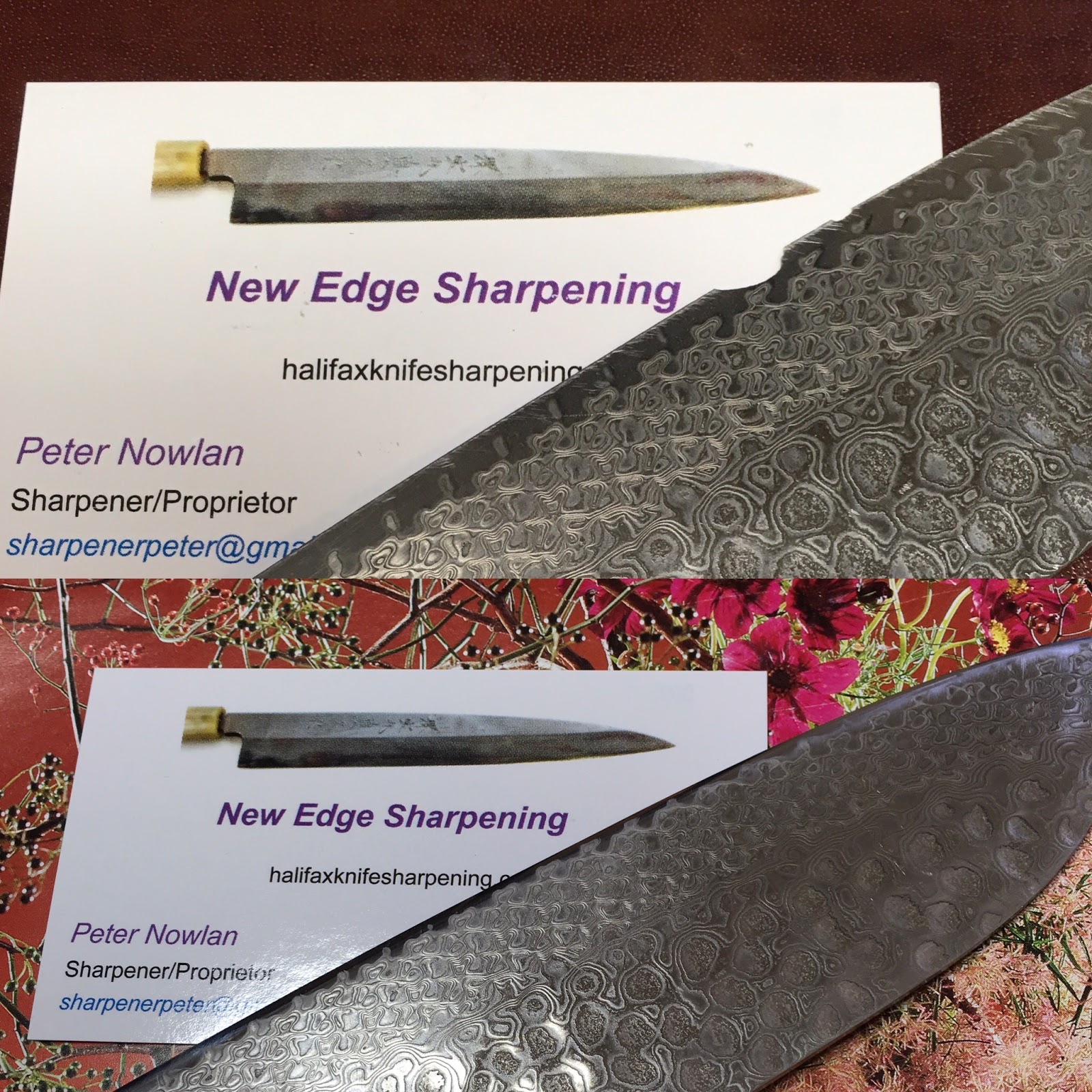
Here is a knife that came in recently and I had to fix it up prior to sharpening it.


     When I get this amount of damage, I have a couple of options, very coarse water stones or my belt sander with the awesome Trizact sharpening belts. In this case I used the belt sander to remove metal along the edge efficiently until the hole disappeared. I can do the work very nicely this way and although I can use the stones as well, this is quicker. 

    Once I get to the point where that new edge is formed, I stop the work with the belt sander and shift to the water stones and I always start with my most coarse stone which is now a 180 grit Naniwa. It isn't good enough to just sharpen the knife, yes it would be very sharp of course but it would not be as thin as it was when it was new so I have to thin it first. I do this by grinding metal at a very acute angle, the knife is basically laying flat on the stone but I am careful here. I don't want the stone to scratch the blade, especially this damascus pattern so I lift the spine just enough to clear the blade, it is a degree or so.


  I shift from coarse to finer stones at this Thinning Angle until I am satisfied, the knife is still dull at this point. Then I just raise the angle to my sharpening angle which was 15 deg for this knife and then I sharpen it. 

   If I did all the work by hand, I would be doing the repair work with the knife held at an angle such as the one in the bottom picture, almost 90 deg and then I just grind on a coarse stone until the metal is removed enough to get to the bottom of that hole that was in the edge. I shift from about 80 deg on one side to 80 deg on the other side to raise burrs on each side.


This process is something I repeat about twice a week at the very least, sometimes every day.

Now on to another topic.

LEATHER STROP DAMAGE.


     I am always nicking my leather strops with the knife, no matter how careful I am. But also, my edges are passing over the surface of that strop about 100 times a day. I found that using some very fine sandpaper on the surface can smooth out those rough spots that I make, extending the life of the strop. It is just a matter of being very gentle and it doesn't take long at all. It will change the colour of the leather but that's fine with me.


All the best
Peter